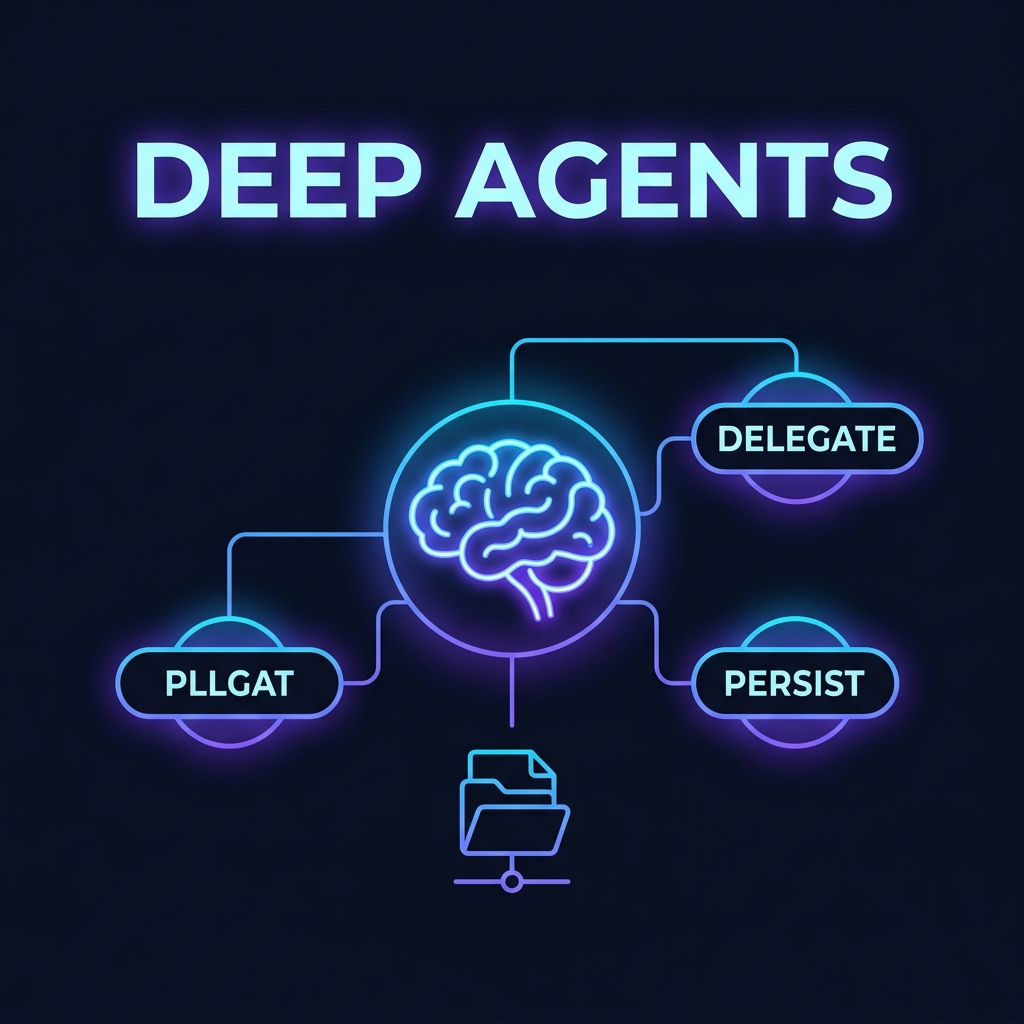
Building Deep Agents with LangChain
A comprehensive 6-part developer's guide to building production-grade deep agents using LangChain — featuring planning, persistent tool-calling harnesses, subagent delegation, context engineering, SQLite checkpointers, and domain-specific customization.
Learning Path & Timeline
- Part 1•2026-06-17•Editorial
What Are Deep Agents? The Architecture That Changes Everything
Deep agents are not just smarter chatbots — they plan, delegate, persist state to files, and resume work across sessions. Learn the architectural principles that make them viable in production and build the foundations of DevPulse, a real AI-powered code review system.
- Part 2•2026-06-18•Editorial
The Deep Agent Harness: Models, Tools & Middleware
The harness is the execution engine of a deep agent. Learn how to build a production-ready LangChain harness with Pydantic-validated tools, multi-model fallbacks, and a middleware layer for caching, rate limiting, and audit logging — all wired into the DevPulse code review system.
- Part 3•2026-06-19•Editorial
Subagent Architecture: Delegation, Parallelism & Isolation
When a single agent reviewing 23 files is too slow and too context-heavy, you need subagents. Learn how to dynamically spawn isolated child agents, run them in parallel with thread pools, handle failures gracefully, and aggregate findings — all without context pollution between files.
- Part 4•2026-06-20•Editorial
Context Engineering: Write, Select, Compress, Isolate
Prompt engineering gets your agent working. Context engineering gets it to production. Learn the four strategies — Write, Select, Compress, and Isolate — that prevent context rot, reduce token costs by 80%, and maintain reasoning accuracy as task complexity scales. Applied throughout the DevPulse system.
- Part 5•2026-06-21•Editorial
Going to Production: Reliability, Observability & Resumability
Moving DevPulse from a working prototype to a production system. Learn how to implement persistent SQLite checkpointing so agents survive crashes, add LangSmith distributed tracing to debug multi-agent pipelines, inject human-in-the-loop approval gates for high-risk actions, and build cost safeguards that prevent runaway API spend.
- Part 6•2026-06-22•Editorial
Domain-Specific Deep Agents: Model Routing, Tool Registries & The Full DevPulse System
One harness does not fit every programming language, domain, or review type. Learn how to build dynamic tool registries that serve language-specific tools, a model router that assigns the right LLM to the right task complexity, and domain-tuned system prompts — then wire everything together into the complete DevPulse production system.